---
title: "Dose adjustments | Kisqali®"
description: "Learn how to manage KISQALI treatment in ABC with clear dose modification and adjustment guidelines to support tolerability and maintain efficacy."
canonical_url: "https://www.kisqali.com/advanced-breast-cancer/monitoring-and-dosing/dose-adjustments"
meta:
"og:description": "Learn how to manage KISQALI treatment in ABC with clear dose modification and adjustment guidelines to support tolerability and maintain efficacy."
"og:title": "Dose adjustments"
---
**Dose adjustments **
## **Dose management**
### **Dose adjustment guidance in HR+/HER2– EBC.**
### **Neutropenia\***
Full blood counts should be performed before initiating treatment with KISQALI. (1)
After initiation of KISQALI, full blood count should be monitored every 2 weeks for the first two cycles,
at the beginning of each of the subsequent four cycles, then as clinically indicated. (1)
**Grade 1 or 2†**
ANC 1000/mm(3)-sLLN
play\_circle\_outline Continue treatment
**Grade 3†**
ANC 500-<1000/mm(3)
pause\_circle\_outlineUntil recovery to grade ≤2
**Then**
play\_circle\_outline Continue treatment
**Grade 3 recurrence**
pause\_circle\_outlineUntil recovery to grade ≤2
play\_circle\_outline -200mg
**Grade 3†
febrile neutropenia**
ANC <1000/mm(3) with a single fever of >38.3°C \[or >38°C for more than 1 hour]
pause\_circle\_outlineUntil recovery to grade ≤2
**Then**
play\_circle\_outline -200mg
**Grade 4†**
ANC <500/mm(3)
pause\_circle\_outlineUntil recovery to grade ≤2
**Then**
play\_circle\_outline -200mg
\* Please refer to the KISQALI (ribociclib) Summary of Product Characteristics for more information on dose modification and management of neutropenia. (1)
† Grading according to Common Terminology Criteria for Adverse Events (CTCAE). (2)
### **Liver-related adverse events**
Liver function tests should be performed before initiating treatment with KISQALI. (1)
After initiation of KISQALI, liver function tests should be performed every 2 weeks for the first two cycles, at the beginning of each of the subsequent cycles, then as clinically indicated. If grade ≥2 abnormalities are noted, more frequent monitoring is recommended. (1)
**Grade 1\***
\>ULN to 3x ULN†
play\_circle\_outline Continue treatment
**Grade 2\***
\>3 to 5x ULN†
**If grade 2 at baseline**
play\_circle\_outline Continue treatment
**If grade 2 toxicity recurs**
play\_circle\_outline -200mg
**If grade <2 at baseline**
pause\_circle\_outlineUntil recovery to ≤baseline grade
**Then**
play\_circle\_outline Continue treatment
**If grade 3 toxicity recurs**
stop
Permanently discontinue
**Grade 3†
febrile neutropenia**
\>5 to 20x ULN†
pause\_circle\_outlineUntil recovery to ≤baseline grade
**Then**
play\_circle\_outline -200mg
**Grade 4†**
ANC <500/mm(3)
stop
Permanently discontinue
These are dose modifications for ALT and/or AST elevations from baseline without increase in total bilirubin above 2xULN. If patients develop ALT and/or AST >3x ULN along with total bilirubin >2x ULN irrespective of baseline grade, discontinue KISQALI. (1) Also, if dose reduction below 200 mg/day is required, the treatment should be permanently discontinued. (1)
\* Grading according to Common Terminology Criteria for Adverse Events (CTCAE). (2)
† If baseline was normal. (2)
### **QT prolongation**
ECG should be assessed before initiating treatment with KISQALI. (1,2)
Treatment with KISQALI should only be initiated in patients with QTcF values <450 ms. The use of KISQALI should be avoided in patients who already have or who are at significant risk of developing QT prolongation. (1)
**QTcF**
450 - 480 ms
play\_circle\_outline Continue treatment
**QTcF**
\>480 to <500 ms
pause\_circle\_outlineUntil recovery to <481 ms
**Then**
play\_circle\_outline -200mg
**Recurrence of QTcF ≥481 ms**
pause\_circle\_outlineUntil recovery to <481 ms
**Then**
play\_circle\_outline -200mg
**QTcF**
\>500 ms
pause\_circle\_outlineUntil recovery to <481 ms
**Then**
play\_circle\_outline -200mg
**QTcF interval**
\> 500 ms or >60 ms increase from baseline\*
stop
Permanently discontinue
If dose reduction <200 mg/day is required, the treatment should be permanently discontinued. Appropriate monitoring of serum electrolytes (including potassium, calcium, phosphorus and magnesium) should be performed before initiating treatment, at the beginning of the first six cycles and then as clinically indicated. Any abnormality should be corrected before initiating treatment with and during treatment with KISQALI. (1)
\* In combination with Torsade de Pointes or polymorphic ventricular tachycardia or signs/symptoms of serious arrhythmia. (1)
## **Dose modification**
### **KISQALI single-strength tablets make dose reduction simple and convenient. **(1)
**Dose reductions with KISQALI mean no need for new mid-cycle prescriptions or additional costs. (1)**
**Recommended starting dose**
**3**
Tablets
(600 mg)
**1st reduction**
**2**
Tablets
(400 mg)
**2nd reduction**
**1**
Tablet
(200 mg)
Dose adjustments for AEs should be made in a stepwise order by reducing the number of tablets taken. If dose reduction below 200 mg/day is required, treatment should be permanently discontinued. (1)
Dose modification of KISQALI is recommended based on individual safety and tolerability as per the SmPC. (1)
### **KISQALI OS benefit is not compromised when dose reduction is needed. **(2)
**MONALEESA-2: OS in patients who required dose reduction. **(2)
**62.6% **
(209/334 patients) required
a KISQALI dose reduction
**58.1% **
dose reductions were
due to adverse events
**3 months **
is the median time
to first dose reduction
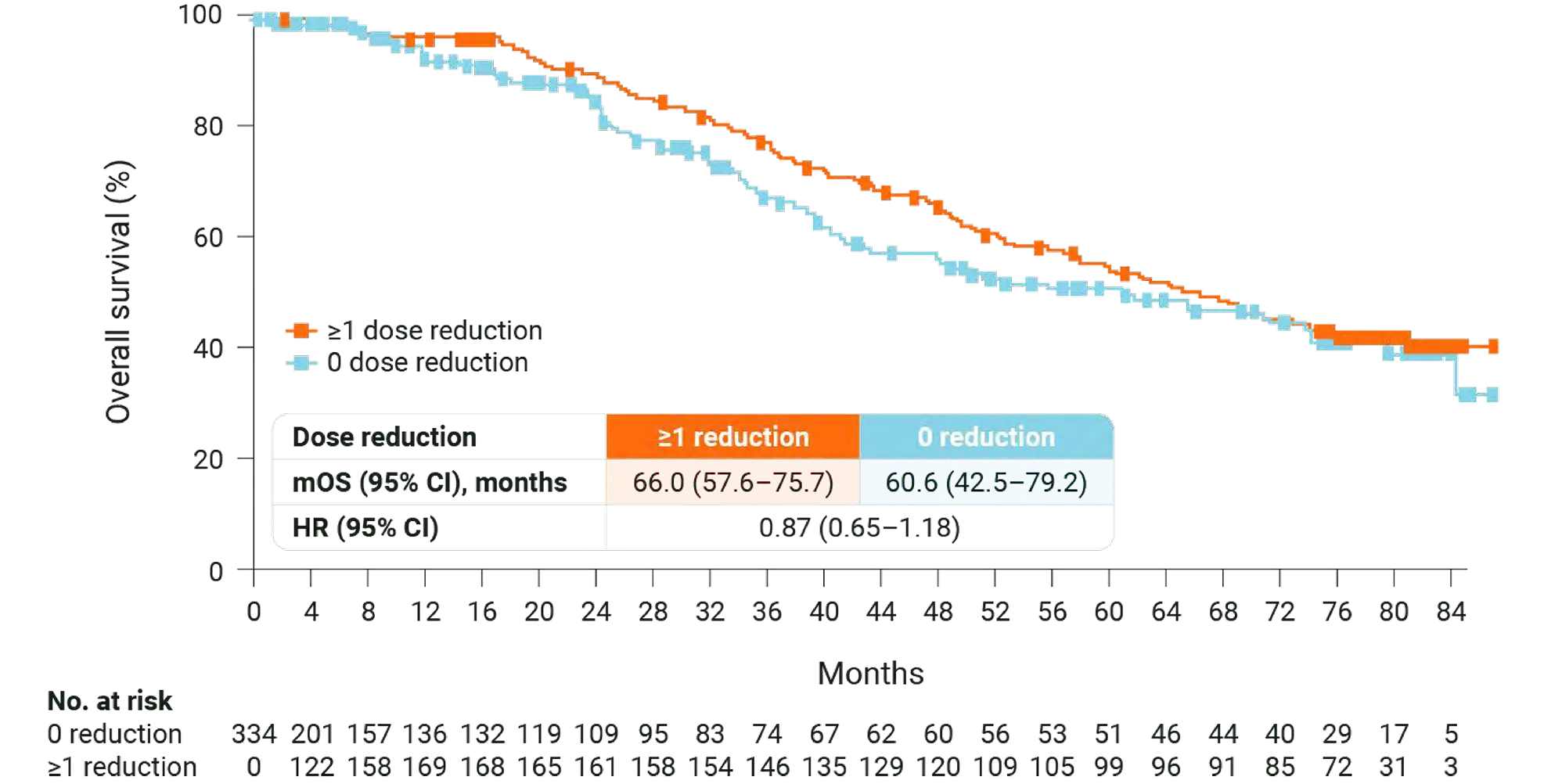
MONALEESA-2: N=668, double-blind, placebo-controlled, 1:1 randomised, multicentre, phase III trial in postmenopausal women with HR+/HER2− ABC. As 1L in advanced disease. No prior endocrine therapy for ABC and no previous systemic chemotherapy for advanced disease. KISQALI 600 mg or placebo orally once daily (3 weeks on/1 week off) + AI (letrozole 2.5 mg continuous). The primary endpoint was locally assessed PFS, and the key secondary endpoint was OS. Other secondary endpoints included the ORR (complete or partial response), the CBR (overall response plus stable disease lasting 24 weeks or more), safety, and QOL assessments. (3)
## Sitemap
See the full [sitemap](/sitemap.md) for all pages.